
From Pain to Purpose: Scaling Femtech with Precision and Purpose
By Dr. Peter M. Kovacs| November 2025
A conversation with Roswitha Verwerand, Dr. Muskaan Bhan, of YON E Health.
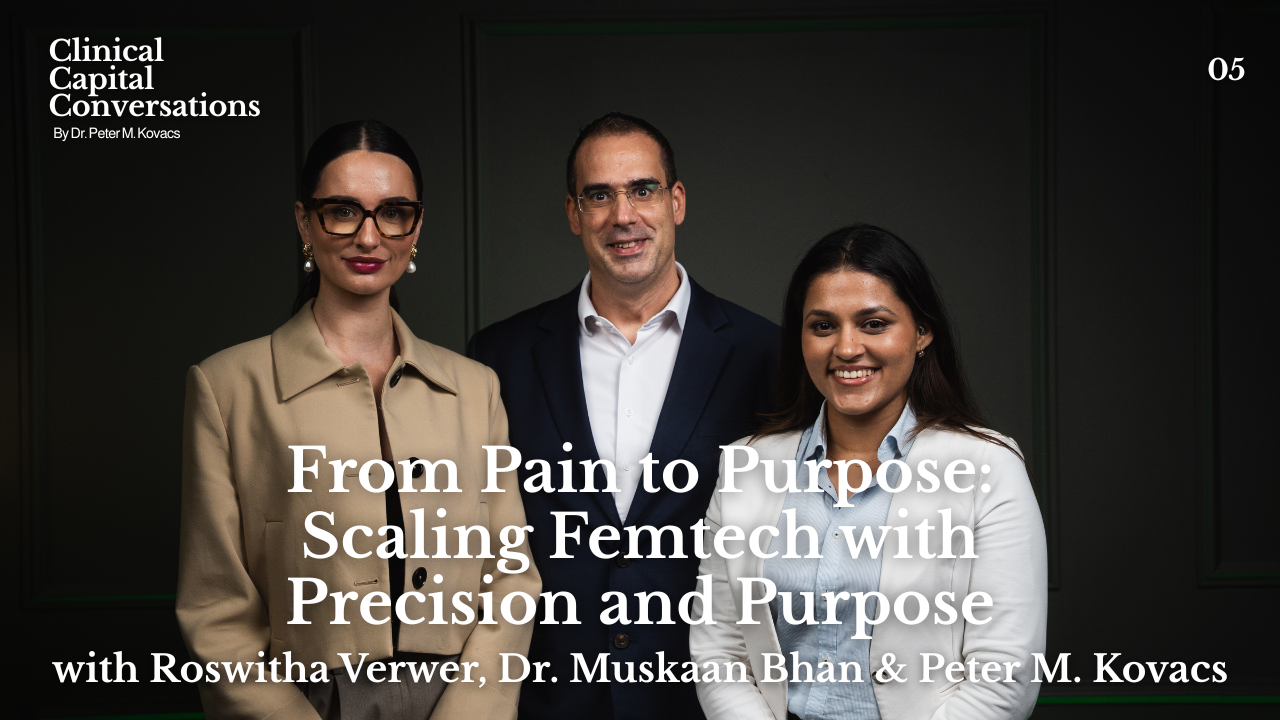
Every generation of healthcare innovation begins the same way: with a group of people who see what everyone else has ignored for too long. Femtech is at that inflection point. It’s no longer an emerging vertical. It’s the infrastructure layer medicine forgot to build. When I sat down with Roswitha Verwer, CEO and Founder, and Dr. Muskaan Bhan, Chief Clinical Officer of YON E Health, the conversation went far beyond sensors, data, and regulation. It was about redesigning trust in healthcare. About proving that empathy and precision can coexist in the same product. And about showing investors that funding women’s health isn’t philanthropy. It’s smart capital allocation.
Turning personal pain into systemic purpose.
Roswitha Verwer grew up in safe houses. Her early life exposed her to the physical and emotional toll of neglected women’s health. Misdiagnosis. Misinformation. Silence. Those experiences didn’t turn her away from the system; they turned her toward building a better one.
She channeled that history into YON E Health, a company developing a medical device that continuously measures vaginal pH and temperature to reveal insights about fertility, infection risk, and hormonal balance. In short: real biomarkers, real-time, from the source.
Dr. Muskaan Bhan, a clinician with years of experience in women’s health, joined after a cold message on LinkedIn. What began as a digital introduction became a mission partnership. Together, they represent what modern health entrepreneurship looks like: cross-disciplinary, globally minded, and personally invested.
The missing data layer.
Until the early 1990s, women were largely excluded from clinical research.
Therapeutics were dosed and designed around a single benchmark: the male body.
That absence of data still shapes outcomes today. pH ranges vary by ethnicity. Hormonal cycles differ across geographies. Even the onset of menopause follows distinct cultural and biological patterns. Yet most diagnostic standards treat all women as one homogeneous category.
YON E Health’s device challenges that. By generating continuous, anonymized, consent-driven data across diverse populations, they’re filling one of the biggest evidence gaps in modern medicine.
For investors, this is not only about aligning with ethics. It’s commercial leverage. The first company to map accurate, multi-ethnic vaginal health data will hold proprietary insights that the pharmaceutical, fertility, and diagnostic industries cannot easily replicate.
From startup to clinical-grade company.
Most early Femtech ventures die in the transition between concept and compliance. YON E Health is taking the opposite route: building regulatory discipline from day one.
Their roadmap is clear:
Proof of concept validated in lab conditions (TRL 2 achieved).
Pre-clinical testing and prototype refinement with simulated biological fluids.
ISO-aligned SOPs and regulatory documentation toward CE mark and FDA submission.
Clinical trials planned within the next 12 months, in partnership with European labs and advisory boards.
Commercial rollout across clinics, followed by direct-to-consumer distribution.
They are not chasing a viral product. They are building a verified one.
The investment gap: why only 2.3 percent of funding goes to women founders.
Roswitha Verwer and Dr. Muskaan Bhan face a reality that numbers alone expose. Less than 3 percent of global venture funding reaches female founders. Within that, only a fraction targets women’s health.
Part of it is discomfort. Investors often hesitate to discuss topics like vaginal microbiomes or fertility in professional settings. Part of it is bias, the unspoken belief that women’s health is a lifestyle category, not a clinical frontier.
But capital flows toward confidence, and confidence grows with data. As YON E Health moves from prototype to trial, it will generate the evidence that de-risks the category for the entire industry.
For investors willing to lead, the returns are asymmetric. Early participation means access to a data moat and an emerging brand with authentic global resonance.
Governance as strategy.
What stands out about this team is not only its purpose but also its governance discipline. They run bi-weekly cross-timezone meetings, use structured project management tools, and maintain direct accountability to their advisory board. Advisors who do not deliver are replaced. Transparency is policy, not marketing.
They embody what I call clinical entrepreneurship: empathy in mission, rigor in execution.
That matters for investors. In my experience, most early-stage failures come from teams that confuse inspiration with infrastructure. YON E Health is building both.
Consent as a competitive advantage.
Recent controversies have damaged public trust in health tech. Users discovered that their personal data had been shared without explicit consent. YON E Health is taking the opposite stance: every data point will be collected with transparent permissions and used solely for research and validated medical purposes. This is not only good ethics. It’s smart business. In regulated markets like the EU, compliance is capital. Companies that design privacy into their product will outlast those who retrofit it under pressure.
Culture and global scale.
The team’s composition mirrors their mission. They operate across Europe, the US, and Asia, addressing both biological and cultural diversity from the start.
Dr. Muskaan Bhan points out the barriers in South Asia, where taboos around vaginal health remain strong. Education will be as important as engineering. The company plans to build workshops and partner with local clinics to bridge those gaps, bringing men into the conversation as well.
This is how scale in healthcare happens: by building both product and permission.
The investor’s view: why I backed them.
As an investor, I evaluate three elements before I commit capital:
People – capability, integrity, and resilience.
Process – clarity of roadmap and governance.
Purpose – measurable impact that aligns with future market needs.
YON E Health scored high on all three.
Their communication was immediate, their diligence material complete, and their values aligned with impact. When a founder responds within hours, not days, and when answers are data-driven rather than aspirational, you invest.
Because capital follows trust, and trust begins with execution.
Femtech as infrastructure.
Femtech is not a side category. It is the next infrastructure layer of personalized medicine.
• Fertility and menstrual health generate continuous data streams.
• Preventive analytics reduce system costs.
• Ethical data frameworks rebuild public trust in biotech.
Investors who treat Femtech as serious healthcare infrastructure will capture both financial and social alpha. Those who ignore it will find themselves priced out of the next wave of clinical innovation.
Leadership and legacy.
What Roswitha Verwer and Dr. Muskaan Bhan are building is not just a device; it's a platform. It’s a statement that healthcare must finally serve all bodies equally.
They are scaling science with empathy.
They are professionalizing a category once dismissed as taboo.
And they are proving that female leadership is not a diversity metric, it’s a performance advantage.
As I often tell founders: Money is a tool, not a value. Impact is the value.
YON E Health is demonstrating both.
The next decade: from device to ecosystem.
Within five years, YON E Health expects clinical validation, CE and FDA approval, and early commercial adoption. Beyond that, the vision expands:
Create research partnerships with hospitals and universities.
Establish educational workshops for clinicians and patients.
Build anonymized global databases for pharmaceutical and academic use.
Reinvest profits into women’s shelters and community health initiatives.
That is the full circle of impact: from data to dignity.
Closing reflection.
In an industry where billions are spent on incremental molecules, it’s often a new sensor or a new mindset that moves the needle.
Femtech is not a charity. It is precision health at scale.
When trauma becomes purpose, and purpose is built with discipline, it attracts the kind of capital that builds legacies.
That is why I invested.
And that is why I believe this space will define the next decade of healthcare innovation.
Listen to the podcast here.